
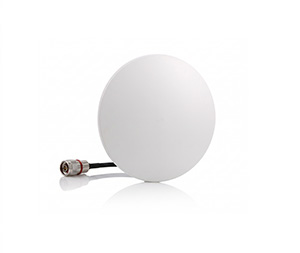
350-3800MHz Ultra-Wideband Indoor OMNI Ceiling Antenna
As a premier solution for passive Distributed Antenna Systems (DAS), the BRTX-1A338-4F-3/4DA model is a top-tier indoor ceiling-mount omnidirectional dome antenna. Engineered by Hefei Bri Electronic & Technology Co.,Ltd, this versatile unit delivers seamless indoor signal distribution across a massive frequency range of 350-698 MHz, 698-960 MHz, 1710-2700 MHz, and 3300-3800 MHz.
Whether you are deploying public safety networks requiring a dependable tetra radio antenna or expanding 5G LTE coverage with a low-interference siso ceiling antenna, this product provides exceptional RF performance. It is meticulously designed to handle a maximum input power of 50W while maintaining a low passive intermodulation (IM3) of -153dBc@2*43dBm.
Technical Specifications
| Specification | Details |
| Model | BRTX-1A338-4F-3/4DA |
| Frequency Range (MHz) | 350-698 / 698-960 / 1710-2700 / 3300-3800 |
| Polarization | Horizontal |
| Gain (dBi) | 3.5 / 3.5 / 3.5 / 4.5 |
| VSWR | <1.8 / ≤1.5 / 1.8 / 1.8 |
| Intermodulation IM3 | -153dBc@2*43dBm |
| Impedance | 50 Ω |
| Maximum Input Power | 50 W |
| Connector Type | 4.310/-Female (with cable) |
| Dimensions | φ300*26 mm |
| Radome Material & Color | ABS, White |
| Operating Temperature | -40~55 °C |
Technical Guide: Understanding Indoor DAS Antennas
What is a ceiling dome antenna?
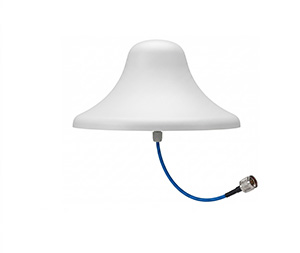
A ceiling dome antenna is a compact, low-profile RF device designed to be mounted inconspicuously on indoor ceilings. Characterized by its circular, dome-like ABS radome, it is engineered to blend into commercial office environments while broadcasting wireless signals in a 360-degree pattern. It is the primary node for providing user equipment with network access in passive DAS configurations.
How does an indoor ceiling antenna work?
An indoor ceiling antenna acts as the transmitting and receiving endpoint of a Distributed Antenna System. It connects via coaxial cables to a central signal source (like an amplifier or base station). By strategically placing these antennas across a building’s ceiling, the system takes the amplified cellular or tetra antenna RF signals and radiates them evenly downward and outward, effectively eliminating dead zones and providing uniform coverage throughout the floor plan.
What is the difference between the vertical and horizontal polarization of the omni directional ceiling antenna?
Polarization refers to the orientation of the electric field of the transmitted radio wave.
Vertical Polarization: The electric field is perpendicular to the ground. This is standard for most mobile communications because handheld devices are typically held upright.
Horizontal Polarization: The electric field is parallel to the ground. The BRTX-1A338-4F-3/4DA specifically utilizes horizontal polarization, which can be advantageous in certain multipath indoor environments where signals reflect off floors and ceilings.
Note on Dual Polarization: While this specific unit is a horizontally polarized siso ceiling antenna, complex networks sometimes utilize a dual polarized ceiling antenna that broadcasts both vertically and horizontally simultaneously to maximize signal reception regardless of how a user holds their mobile device.
Product Advantages
Engineering and Design Benefits of Ceiling Mounted Antennas
The ceiling mount antenna system utilizes a modular design architecture that simplifies installation and aligns with standardized ceiling grids. Developed by a respected indoor ceiling antenna manufacturer, the products feature low-profile housing to comply with aesthetic and safety regulations while optimizing spatial resources. Their construction accommodates ease of integration with existing network infrastructures, reducing deployment times and minimizing disruption. The 5 GHz ceiling antenna variants are engineered for durable performance, supporting diverse mounting options without compromising signal integrity.
Performance Reliability and Operational Value
This indoor ceiling antenna range provides consistent RF coverage with broad frequency adaptability, enhancing wireless network performance in congested indoor environments. The ceiling mounted antennas facilitate improved signal-to-noise ratio and minimize multipath interference, delivering enhanced data throughput essential for business-grade applications. Produced by a reliable ceiling antenna manufacturer, these antennas offer maintenance advantages including straightforward diagnostics and support for software-defined configurations, increasing overall network efficiency and reducing operational costs.
Reviews
There are no reviews yet.