
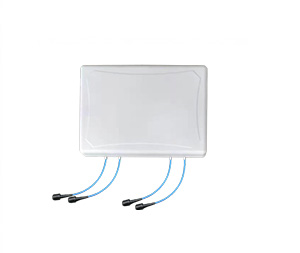
High-Performance 4×4 MIMO Antenna 5G (698MHz – 4000MHz)
Designed for the demanding requirements of modern distributed antenna systems cellular networks, this wideband directional indoor flat antenna provides exceptional coverage from 698MHz to 4000MHz. It is specifically engineered to distribute MIMO and LTE services seamlessly indoors, offering high gain, low return loss, and highly stable performance across 700MHz, 800MHz, 900MHz, and 3800MHz 5G bands.
Compact and lightweight, this 5g mimo 4×4 antenna is built for quick on-wall installation while guaranteeing strict Low PIM performance (≤-150 dBc @ 2x20W) for interference-free, mission-critical communication.
True Wideband Coverage: 698-960 MHz, 1710-2700 MHz, and 3300-4000 MHz.
Low PIM Rating: ≤-153dBc at 2×20 W to minimize passive intermodulation in dense networks.
High Isolation: Exceeds 23 dB in the upper 3300-4000 MHz bands for superior signal integrity.
Dual Polarization: 2x±45° coverage across the entire frequency spectrum.
Electrical & Mechanical Specifications
| Specification | Details |
| Frequency Range (MHz) | 698-960 / 1710-2700 / 3300-4000 |
| Gain (dBi) | 6.0±1 / 6.5±1 / 6.5±1 |
| VSWR | ≤1.8 |
| Isolation (dB) | >15 / >20 / >23 |
| Input Power per Port | 50 watts (maximum) |
| Dimensions (HxWxD) | 308 x 420 x 82 mm |
| Weight | 2.2 kg |
| Connector Type | 4.3-10-Female x 4 (N-female optional) |
| Operational Temperature | -55°C to +60°C |
| Radome Material | ABS, White, RAL9003 |
Technical Guide: Understanding Cellular MIMO Technology
What is a cellular antenna
A cellular antenna is specialized radio frequency (RF) hardware used to transmit and receive cellular signals between mobile devices and base stations. In In-Building Systems (IBS), an indoor flat antenna is strategically placed to eliminate dead zones and propagate consistent RF coverage for LTE and 5G networks throughout commercial structures.
What is a MIMO antenna
MIMO stands for Multiple-Input Multiple-Output. A mimo cellular antenna utilizes multiple transmitters and receivers to send and receive more data simultaneously over the same radio channel. This technology heavily combats signal fading and significantly increases data capacity without requiring additional bandwidth.
How a MIMO antenna works
A MIMO antenna leverages a principle called spatial multiplexing. By bouncing signals off walls and objects, the antenna creates multiple distinct paths for the data to travel. The transmitting and receiving antennas combine these fragmented signals to reconstruct the data stream, turning multipath interference—traditionally a problem in RF engineering—into an advantage that boosts throughput and network reliability.
2×2 vs 4×4 MIMO antenna
The numbers dictate the amount of transmitting and receiving antennas. A mimo 2×2 panel external antenna utilizes two antennas to transmit and two to receive, effectively doubling the standard capacity. Upgrading to a 4×4 mimo antenna 5g doubles that capacity again, using four antennas on each end. A 4×4 system is vastly superior for dense 5G environments, offering significantly faster data rates, better signal penetration, and a more robust connection for end-users.
How to install a MIMO antenna
Proper installation is crucial for maximizing isolation and minimizing PIM. This specific unit utilizes an on-wall mounting kit. When mounting, ensure the antenna is positioned clear of large metallic obstructions. Connect the designated 4×4 mimo antenna cable lines securely to the 4.3-10 female connectors , ensuring a proper torque to prevent signal leakage and maintain the stringent VSWR rating of ≤1.8.
Reviews
There are no reviews yet.