
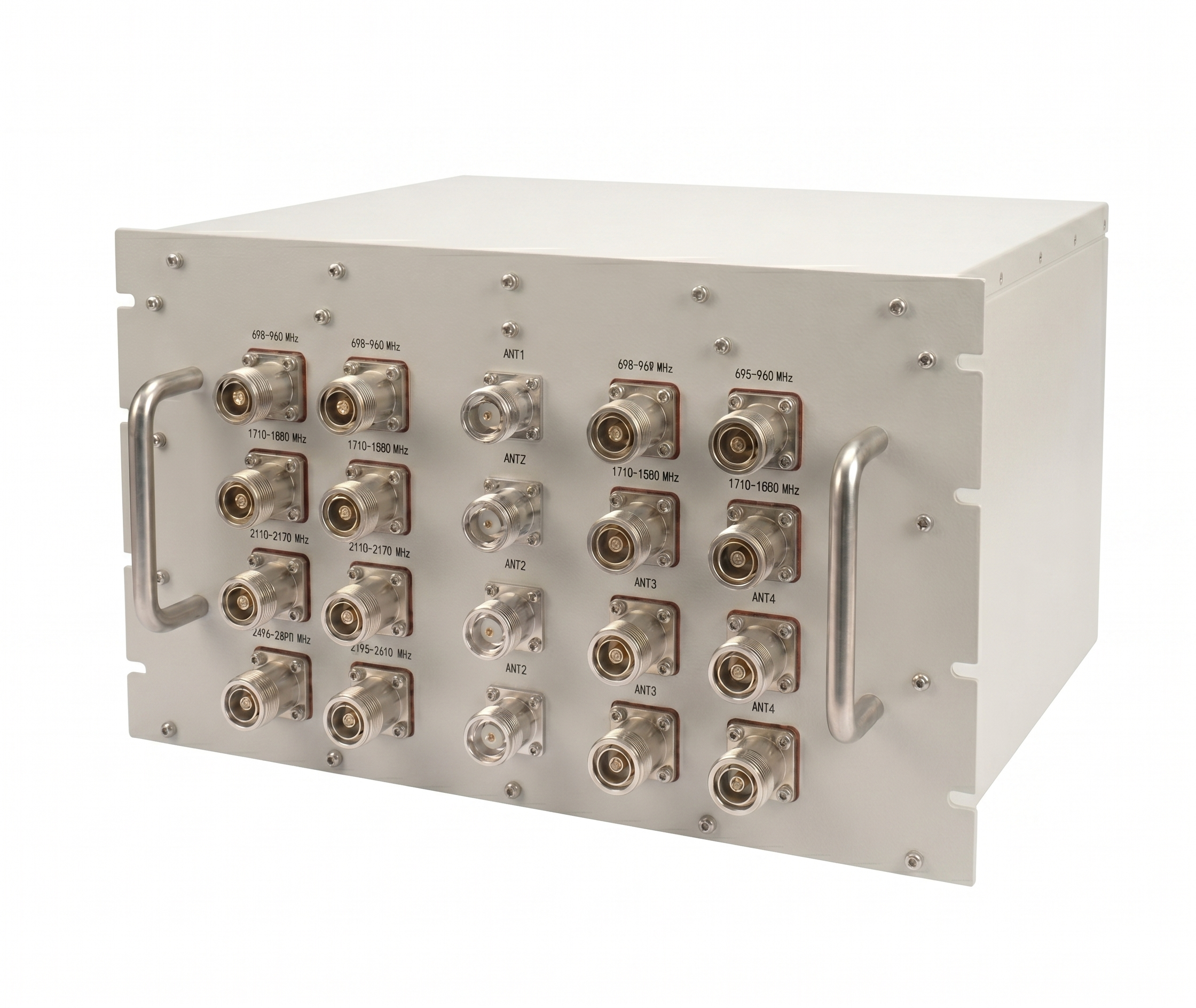
Hefei BRI Electronic & Technology Co., Ltd. proudly presents our high-capacity 18-In 6-Out POI point of interconnect, an essential point of interconnection in telecom engineered specifically for advanced in-building distributed antenna systems (DAS). Designed to seamlessly integrate multiple multi-operator frequencies from 800MHz to 2690MHz, this 19-inch 8U rack-mounted unit is a critical component for managing complex signals within any modern BTS ( base-station transceive system).
Our poi point of interconnect efficiently combines GSM900, LTE1800, LTE2100, and LTE2600 bands—including 5G MIMO configurations —ensuring exceptional cross-band isolation (>55dB) and ultra-low PIM (≤ -150dBc @ 2x43dBm). This strict signal management guarantees pristine clarity across your entire antenna distributed system.
As a professional manufacturer of RF passive products, Hefei BRI delivers robust solutions tailored to your network architecture. Whether your infrastructure requires this massive 18-port POI for a dense indoor deployment or a rugged outdoor dual band combiner to extend coverage, our equipment offers unmatched reliability. Pair this high-isolation POI with our standard dual band combiner to fully customize your site’s passive distribution network and future-proof your telecommunications capabilities.
The Critical Applications of POI in Modern Telecommunications
As global data consumption surges, telecom operators face the massive challenge of expanding network capacity without cluttering cityscapes with redundant infrastructure. The solution lies in the poi point of interconnect (Point of Interface). By intelligently combining multiple radio frequency signals, a POI serves as the central nervous system for shared network deployments.
Here is a look at the primary applications of this critical point of interconnection in telecom:
1. High-Density In-Building Systems (IBS)
Modern commercial buildings, stadiums, subway systems, and airports are notorious for blocking cellular signals. To provide seamless coverage, facility managers deploy In-Building Systems (IBS). A POI is used at the head-end of the IBS to take feeds from multiple mobile operators (e.g., AT&T, Verizon, T-Mobile) and combine them into a single, unified signal. This allows all carriers to share the same indoor antenna network, drastically reducing installation costs and saving valuable server room space.
2. Multi-Operator Distributed Antenna Systems (DAS)
In expansive environments like college campuses or smart city districts, a neutral host DAS is often deployed. Similar to an IBS, a DAS relies on a POI to aggregate varying frequencies—from legacy 2G/3G bands up to high-capacity 5G bands (like 3500MHz). By ensuring ultra-low Passive Intermodulation (PIM) and high cross-band isolation, the POI prevents carrier signals from interfering with one another as they are distributed across the network.
3. Base Transceiver Station (BTS) Upgrades
As carriers upgrade their existing cell towers to support 5G, they rarely rip out the old infrastructure. Instead, they integrate new spectrums alongside the old ones at the BTS (base-station transceive system). A high-port POI (such as an 18-In 6-Out configuration) allows engineers to cleanly merge these diverse signals before sending them up the tower.
Seamless Integration with Passive Networks
The effectiveness of a POI relies heavily on the quality of the surrounding passive components. Once the signals are combined at the POI, they are often routed through a standard dual band combiner or a rugged outdoor dual band combiner to further split or direct specific frequencies to targeted sector antennas. Manufacturing these components with strict PIM controls and high IP ratings ensures the entire network remains reliable under heavy traffic.
Technical Specifications
| Feature | Specification |
| Input Configurations | GSM900, LTE1800, LTE2100, LTE2600 (Including MIMO)
|
| Frequency Range | 800-960MHz, 1710-1880MHz, 1920-2170MHz, 2500-2690MHz
|
| Insertion Loss | < 6.5 dB
|
| Isolation (Same Band) | > 23 dB
|
| Isolation (Different Band) | > 55 dB
|
| Return Loss | ≥ 18 dB
|
| VSWR | ≤ 1.3
|
| Intermodulation (PIM) | ≤ -150 dBc (with 2 x 43dBm)
|
| Maximum Input Power | 200 W
|
| Impedance | 50 Ω
|
| Operating Temperature | -10°C to +65°C
|
| Size | 19 Rack 8U
|
| Connector Type | 24-DIN-Female
|
Frequently Asked Questions
1. What is the difference between a standard dual band combiner and a POI point of interconnect?
A dual band combiner is typically designed to merge two specific frequency bands (such as 698-960MHz and 1710-2690MHz) into a single feed, making it ideal for targeted sector routing. Conversely, a poi point of interconnect is a much larger, multi-port system (such as an 18-In 6-Out configuration). It serves as a central point of interconnection in telecom, designed to aggregate multiple multi-operator signals at the BTS (base-station transceive system) before distributing them through a high-capacity in-building or distributed antenna system 5g.
2. Are Hefei BRI components built to withstand harsh outdoor environments?
Yes, our passive network solutions are strictly engineered for environmental resilience. For example, our outdoor dual band combiner features an IP67 ingress protection rating and operates reliably in extreme temperatures ranging from -40℃ to +65℃. This ensures continuous, low-interference performance whether the unit is mounted on an exterior macro tower or an exposed rooftop DAS node.
3. Why is ultra-low PIM critical for an rf triplexer or POI in modern networks?
Passive Intermodulation (PIM) creates background noise that severely degrades network speed, capacity, and call quality. In dense, multi-carrier environments like a modern distributed antenna system 5g, preventing signal distortion is critical. Hefei BRI engineers every poi point of interconnect and RF combiner to maintain ultra-low PIM levels (typically ≤ -150dBc or ≤ -153dBc at 2x43dBm), guaranteeing maximum data throughput and preventing cross-band interference.
Reviews
There are no reviews yet.