In the high-stakes world of wireless communication, the “how” and “when” of data transmission are governed by two fundamental architectures: Time Division Duplexing (TDD) and Frequency Division Duplexing (FDD). While both serve the singular purpose of allowing bidirectional communication (uplink and downlink), their historical trajectories and technical trade-offs have shaped the mobile landscape from the first brick phones to the burgeoning 6G era.
A Brief History of Duplexing
The FDD Era: The Legacy of Voice
Frequency Division Duplexing was the natural heir to analog radio traditions. In the early days of mobile telephony (1G and 2G/GSM), communication was primarily symmetric—you talked as much as you listened. FDD was perfectly suited for this. It functions like a twin-track bridge: one dedicated lane for transmitting (uplink) and one for receiving (downlink), separated by a “guard band” of empty spectrum to prevent interference.
Because early hardware struggled with rapid switching, FDD’s “always-on” nature in both directions made it the global standard for decades. It provided the steady, low-latency stream required for high-quality voice calls.
The TDD Era: The Rise of Data
Time Division Duplexing, by contrast, functions like a single-lane bridge with a very fast traffic light. It uses the same frequency for both uploading and downloading but separates them by time. Historically, TDD was viewed as the “underdog.” It was famously championed by China’s TD-SCDMA (3G) and later TD-LTE (4G) standards.
Initially, TDD faced challenges with synchronization. If the “traffic light” wasn’t perfectly timed across a network, towers would interfere with each other. However, as processors became faster and more precise, the inherent flexibility of TDD began to outshine the rigid structure of FDD.
Technical Comparison: Symmetry vs. Flexibility
To understand why the industry has shifted, we must compare their operational DNA. The following diagrams provide a visual summary of how these technologies allocate radio resources.
Diagram 1: Spectrum Efficiency and Allocation
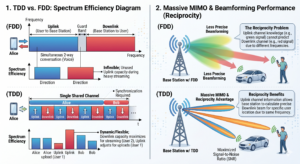
Figure 1 (Left): FDD vs. TDD Spectrum Allocation. The top section illustrates FDD, showing parallel blue (Uplink) and red (Downlink) channels running simultaneously, separated by a physical Guard Band. As the ‘Spectrum Efficiency’ chart notes, this is ‘Inflexible,’ leading to wasted capacity when usage is asymmetric. The bottom section shows TDD, utilizing a ‘Single Shared Channel’ that alternates rapidly over time between users (Alice and Bob) and directions. The efficiency chart highlights how TDD dynamically adjusts to maximize downlink capacity for heavy streaming.
| Feature | Frequency Division Duplexing (FDD) | Time Division Duplexing (TDD) |
| Spectrum Usage | Requires paired spectrum (two separate bands). | Requires unpaired spectrum (one single band). |
| Hardware | Requires a “duplexer” to filter signals, adding cost and size. | Requires a high-speed electronic switch. |
| Traffic Handling | Fixed/Symmetric. Equal space for UL and DL. | Dynamic/Asymmetric. Can shift resources to DL. |
| Interference | Easier to manage; lanes are physically separate. | Complex; requires tight network synchronization. |
| Latency | Generally lower for consistent, small packets. | Slightly higher due to waiting for the time slot. |
Why TDD is Winning the Modern Wireless War
While FDD dominated the 20th century, TDD is the undisputed king of the 5G and 6G era. If you look at modern spectrum auctions, the “mid-band” (3.5GHz) and “high-band” (mmWave) deployments are almost exclusively TDD. Here is why:
1. The Data Asymmetry Reality
The way we use the internet has changed. Today, we stream 4K video, download massive apps, and scroll through image-heavy feeds. This creates a massive imbalance where the downlink (DL) often requires 10 times more capacity than the uplink (UL). FDD’s fixed structure (seen in Fig 1, top) results in wasted Uplink capacity, whereas TDD dynamically reallocates that same spectrum for immediate Downlink needs.
2. Massive MIMO and Beamforming (The Reciprocity Advantage)
This is perhaps the critical technical reason for TDD’s dominance in 5G. Modern antennas use Massive MIMO (Multiple Input, Multiple Output) to focus signals directly at a user location.
Diagram 2: Performance and Reciprocity
The advantage of TDD in advanced antenna systems is clearly illustrated below:
Figure 2 (Right): FDD vs. TDD Beamforming Performance. This diagram compares how base stations utilize antenna arrays. In FDD (Top), the tower exhibits ‘Less Precise Beamforming’ because the different frequencies destroy ‘Channel Reciprocity’; knowledge of the green uplink signal cannot predict the path of the red downlink signal. In TDD (Bottom), use of the same frequency creates ‘Reciprocity Benefits.’ The tower uses the uplink signal to calculate perfect, ‘Precise Beams’ that target the user, maximizing the Signal-to-Noise Ratio (SNR).
In TDD, because the UL and DL use the same frequency, the base station can analyze the precise path the uplink signal took to reach the tower (Fig 2, bottom). It can then mathematically reverse this path to “beam” the downlink data directly back to the user with pinpoint accuracy, a property known as Channel Reciprocity.
3. Spectrum Scarcity and “Unpaired” Bands
Spectrum is a finite, multi-billion-dollar resource. FDD requires “paired” spectrum—two chunks of airwaves separated by a specific distance. Finding such perfectly spaced pairs in an overcrowded radio environment is increasingly difficult. TDD only needs a single contiguous block of spectrum (Fig 1, bottom), making it much easier for regulators to clear and auction.
4. Cost and Integration
In the past, the “switches” required for TDD were expensive. Today, silicon is cheap, but physical filters (duplexers) required for FDD remain complex and bulky. FDD duplexers are tuned to specific frequency pairs, limiting design flexibility. TDD hardware is generally more compact and “software-defined,” allowing a single radio unit to be more easily adapted to different global markets.
Conclusion
The shift from FDD to TDD represents a shift from a hardware-centric, voice-first world to a software-defined, data-first world. While FDD remains vital for “coverage layers” (the low-frequency signals that travel through walls and over miles), TDD is the engine driving the high-speed, high-capacity future. By leveraging channel reciprocity for Massive MIMO and allowing for asymmetric data flows, TDD has proven itself as the most efficient way to squeeze every bit of value out of our increasingly crowded airwaves. As we look toward 6G, the debate is largely over: the future of wireless is timed to perfection.