
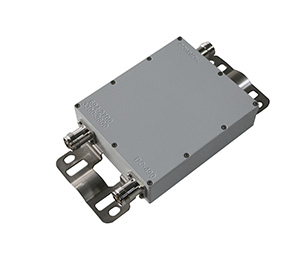
Welcome to Hefei Bri Electronic & Technology Co., Ltd. As an industry-leading manufacturer of premium RF passive components, we engineer solutions designed to optimize multi-carrier connectivity for global telecommunications firms and system integrators. Our DC–490MHz / 694-2700 & 3300-3800MHz Dual-band Combiner (Model: BRC2-DC3800-B) represents the gold standard in RF multiplexing. This high-performance dual band combiner is specifically optimized for 4G/5G macro and small cell deployments , delivering high isolation (≥50dB), exceptionally low insertion loss (<0.3dB), and excellent intermodulation stability.
Electrical Specifications
| Model | BRC2-DC3800-B | |
| Frequency band | Port 1 | Port 2 |
| DC – 490MHz | 694-2700&3300-3800 MHz | |
| Insertion loss | <0.3dB | |
| Return loss | ≥19dB | |
| Isolation | ≥50dB | |
| Intermodulation | ≤-160dBc@2*43dBm | |
| Impedance | 50 Ω | |
| DC/AISG | By-pass(max.3000mA) @Port1 | |
| Lightning protection | 10KA;10/350us pulse | |
| Input power | 200 W(avg.) | |
| Operation temperature range | -40°C to +65°C | |
| Storage temperature range | -40 °C to +80 °C | |
| Relative humidity | 5%-95% | |
| Ingress protection | Indoor or outdoor (IP66) | |
Engineered for Rugged Environments
Telecom infrastructure requires components that will not fail under environmental stress. The BRC2-DC3800-B serves as a highly reliable outdoor dual band combiner, featuring a compact, durable IP66-rated design built for demanding installations. Capable of operating flawlessly in extreme temperatures ranging from -40°C to +65°C, this unit delivers the robust, long-term performance expected of a premium dual band combiner kathrein equivalent. It also features seamless AISG integration for easy remote control and 10KA lightning protection.
Detailed Application in Passive Distributed Antenna Systems (DAS)
Within a passive Distributed Antenna System, managing heavy coaxial runs efficiently is critical for reducing CAPEX and installation time. This combiner is heavily utilized by tower crews and indoor integrators to merge distinct frequency streams—such as public safety and commercial cellular—onto a single shared feeder cable. Instead of running parallel RF infrastructure, the combined signal is pushed efficiently to the distribution network, ultimately transmitting out of panel or omni ceiling antennas. This drastically minimizes tower loading, wall clutter, and overall material costs.
The Wideband Advantage: DC-490MHz vs. Traditional 698-3800MHz Combiners
While traditional 698-3800MHz combiners are restricted purely to modern commercial cellular networks, our advanced model provides a future-proof frequency range. Port 1 is dedicated to the expansive DC–490MHz band, while Port 2 handles 694-2700 & 3300-3800 MHz. This critical inclusion of the DC-490MHz spectrum allows network engineers to seamlessly integrate VHF, UHF, and vital TETRA band frequencies utilized by emergency responders. Consequently, building owners can meet strict municipal public safety mandates while simultaneously driving high-bandwidth 5G coverage—all on the same physical layer.
The Critical Importance of Low PIM (-160dBc)
Passive Intermodulation (PIM) is the primary cause of signal degradation in modern ultra-wideband networks. When multiple high-power signals interact within a passive component, they can create harmful interference that cripples data throughput and voice clarity. The BRC2-DC3800-B handles a 200W average input power while maintaining an ultra-low PIM rating of ≤-160dBc@2*43dBm. This strict intermodulation stability ensures that both public safety uplinks and dense 5G data streams remain pristine, interference-free, and operating at maximum capacity.
Reviews
There are no reviews yet.