
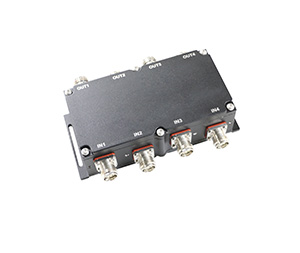
Modern cellular networks require seamless signal integration, and Hefei Bri Electronic & Technology Co.,Ltd delivers exactly that. Our flagship 4×4 hybrid matrix is a robust, high-performance wideband hybrid coupler engineered specifically for complex cellular distributed antenna systems (DAS). Supporting critical frequency bands including 700, 800, 900, and ultra-fast 3800MHz 5G networks, this china rf hybrid coupler provides unparalleled reliability for multi-carrier base station deployments.
Built as an advanced 90 degree hybrid coupler s matrix, it guarantees excellent phase accuracy, high port-to-port isolation, and ultra-low passive intermodulation (PIM) to keep your infrastructure running at maximum capacity
Technical Specifications: 4×4 Wideband Hybrid Matrix
| Frequency band | 617-3800MHz |
| Insertion loss(dB) | ≤6.0+1.5 |
| VSWR | ≤1.3 |
| Isolation(dB) | ≥23 |
| Intermodulation (dBc) | ≤-160dBc (with 2×43dBm) |
| Impedance (Ω) | 50 |
| Power Rating | 300 W (avg.) |
| Operation temperature | -25 °C to +75 °C |
| Storage temperature | -40 °C to +85 °C |
| Relative humidity | 5% – 95% |
| Application | IP65 |
What is a Hybrid Coupler?
A hybrid coupler is a highly specialized RF passive component used extensively in telecommunications. Its primary function is to take an input radio frequency signal and split it equally between two output ports, introducing a strict 90-degree phase difference between those outputs. Conversely, it can be used to merge multiple signals together. Because of its internal design, it inherently provides high isolation between the input ports, preventing signals from bleeding into one another.
How a Hybrid Coupler as a Combiner Can Work
When utilized in a DAS network, a hybrid coupler is frequently deployed as a combiner to streamline infrastructure. Here is how it works:
Signal Input: Two separate wireless carriers (for example, an 800MHz LTE signal and a 3800MHz 5G signal) are fed into the two input ports of the coupler.
Phase Cancellation: Because the coupler applies a 90-degree phase shift, it mathematically isolates the input ports from each other.
Unified Output: The independent signals are safely combined and distributed equally to the output ports. This allows multiple base stations to share the same coaxial cable and antenna network without their high-power transmitters interfering with or damaging each other.
In the case of a 4×4 hybrid matrix, this combining capability is expanded. It uses a cascaded internal network of couplers to take four distinct carrier inputs and distribute them evenly across four identical outputs, making it the backbone of high-density neutral-host networks.
Hybrid Coupler Applications
Our advanced hybrid solutions are integral to modern telecommunications, featuring in:
Cellular Distributed Antenna Systems (DAS): Combining multiple carrier frequencies for balanced, multi-floor in-building wireless coverage.
Base Station (BTS) Co-location: Allowing different telecom operators to share the same physical tower or indoor antenna infrastructure without interference.
Balanced Amplifier Design: Splitting and combining signals around RF amplifiers to improve voltage standing wave ratio (VSWR) and protect sensitive equipment from reflected power.
Product Advantages
Design and Integration Superiority for Complex RF Systems
The 4×4 hybrid matrix adopts a modular 90-degree coupling arrangement that simplifies connection schemes for multi-port signal distribution. Utilizing advanced internal balancing, the design reduces cross-port interference and delivers consistent phase relationships between outputs. This system-level design advantage reflects the expertise of its hybrid coupler manufacturer in producing reliable components fit for scalable RF network configurations. Its robust enclosure meets industrial IP65 standards, allowing versatile deployment without compromise to structural integrity. Such thoughtful engineering helps network installers reduce system complexity and improve maintainability.
Enhanced Usability and Reliability for Network Performance
This hybrid coupler combiner provides exceptional performance with easy installation and integration into existing RF infrastructures. Its operational stability across a wide temperature range and environmental protections ensures minimal downtime and consistent RF parameters. The device’s low passive intermodulation characteristics extend network lifespan by reducing signal distortion, thereby improving end-user experience in residential or commercial cellular coverage. By incorporating this 2×2 hybrid coupler-grade technology scaled up to a 4×4 matrix, users achieve high spectral efficiency and return on investment through scalable and reliable multi-carrier support.
Reviews
There are no reviews yet.