
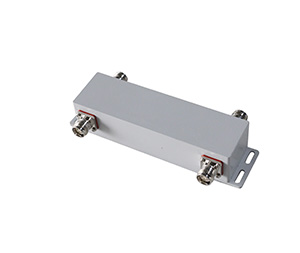
Ensure flawless signal integration across your cellular distributed antenna system (DAS) with our premium 2×2 hybrid coupler. Manufactured to exacting standards by Hefei Bri Electronic & Technology Co.,Ltd, this wideband hybrid coupler seamlessly covers the entire spectrum from Tetra 400MHz up to the 5G 3800MHz band.
Engineered to operate as a high-efficiency 3 db coupler hybrid combiner, this unit combines two wireless carrier signals into a single feed while maintaining strict port isolation. The true 90 degree hybrid coupler design ensures phase accuracy and optimal power distribution, making it an essential RF passive product for neutral host DAS, in-building wireless coverage, and multi-carrier base station deployments.
Core Technical Specifications
We know that modern B2B telecom infrastructure requires stringent performance parameters. This coupler delivers the exact specifications needed for high-end international integrations:
| Specification | Details |
| Frequency Range | 380 – 3800 MHz (Includes Tetra, 700/800/900MHz, and 5G) |
| Coupling / Insertion Loss | 3.0 dB ± 0.6 dB |
| Isolation | ≥ 30 dB |
| Passive Intermodulation (PIM) | -160 dBc (3rd Order, 2×43 dBm) |
| Phase Balance | 90° ± 5° |
| VSWR | ≤ 1.25 |
| Input Power | 200 Watts |
| Connector Type | 4.3-10-Female (x4) |
The Advantage of High Isolation (≥30dB)
In a densely packed cellular distributed antenna system, signal integrity is paramount. This coupler is engineered with an exceptional isolation rating of ≥30dB, providing a distinct advantage over standard market alternatives:
Transmitter Protection: High isolation prevents signal leakage between the input ports. When combining two high-power base stations (BTS), ≥30dB isolation guarantees that power from one transmitter does not feed back into and damage the other.
Reduced Intermodulation: By keeping the RF paths strictly separated, it drastically reduces the chances of creating unwanted passive intermodulation (PIM) products, maintaining the ultra-low PIM rating of -160dBc.
System Stability: It ensures the entire DAS network remains balanced and stable, even when frequency bands are closely spaced.
Deep Dive: 3dB Hybrid Coupler Applications
A 3db 90 degree hybrid coupler is a highly versatile RF component used primarily to combine or split signals in complex cellular networks. Because it splits power equally (resulting in a 3dB loss per output) and introduces a 90-degree phase shift, it offers several critical operational benefits:
Multi-Carrier Combining: It functions as a 3 db coupler hybrid combiner, allowing two different frequency bands (e.g., a Tetra 400MHz signal and a 3800MHz 5G signal) to share the same coaxial infrastructure without interference.
Balanced Amplifiers: The 90-degree phase shift is utilized in amplifier design to cancel out reflected signals, improving the overall VSWR and protecting sensitive radio equipment.
Built-In Redundancy: If one input fails, the remaining signal is still evenly distributed across both N-female output ports, ensuring that no sector of the building loses coverage entirely.
Technical Showdown: 2×2 Hybrid Coupler vs. 4×4 Hybrid Matrix
When expanding your DAS infrastructure, choosing between a standard 2×2 hybrid coupler and a larger hybrid matrix depends on your carrier density and sectorization needs.
| Feature | 2×2 Hybrid Coupler (This Product) | 4×4 Hybrid Matrix |
| Port Configuration | 2 Input Ports, 2 Output Ports (equipped with N-female connectors). | 4 Input Ports, 4 Output Ports. |
| Primary Use Case | Ideal for combining two base station sectors or two different frequency bands into two shared output feeder lines. | Essential for massive neutral-host DAS, combining four distinct carriers into four identical outputs. |
| Coupling Loss | 3 dB (Power is split in half). | 6 dB (Power is split into quarters). |
| Architecture | A single RF junction. Simple, cost-effective, and highly reliable. | Internally constructed by cascading four individual 3dB hybrid couplers. |
| Isolation | Exceptional isolation (≥30dB). | High isolation, but generally lower overall system isolation due to cascaded internal paths. |
Use Scenarios
Optimizing Distributed Antenna Systems for Urban Networks
In urban telecom infrastructure, distributed antenna systems require components that minimize interference and maintain signal clarity across multiple frequency bands. The ultra wide band low PIM RF components, including the 2×2 hybrid coupler and 3db hybrid coupler modules, are crucial in such settings to ensure clean signal combining and splitting within DAS architectures. Their low intermodulation profile helps comply with stringent network performance standards, facilitating enhanced coverage and capacity. Network operators integrate these parts seamlessly into their RF feeder systems to achieve uniform wireless distribution with reduced signal degradation in dense environments.
Supporting Public Safety Communication Enhancements
For public safety communications, the integrity and reliability of wireless signals are mission-critical. These RF components function as essential passive elements within repeater systems and booster setups, utilizing hybrid coupler combiner technology to maintain high signal purity and link stability. The robust design and compliance with international manufacturing standards enable deployment in both indoor control centers and outdoor emergency sites. Such integration supports multi-carrier signal handling and ensures communication continuity during critical operations, reaffirming the product’s value in high-demand wireless communication applications.
Product Advantages
Structural and System Design Excellence
The modular design of this ultra wide band low PIM RF device series incorporates advanced 2×2 hybrid coupler and hybrid coupler combiner topologies tailored for scalable system configurations. The inclusion of sophisticated hybrid matrix arrangements within the 3db hybrid coupler ensures minimal signal loss and balanced output phases. This structural approach facilitates ease of integration into existing RF architectures and supports flexible network layouts, enabling engineers to optimize system topology without compromising on intermodulation suppression or maintenance accessibility.
Enhanced Performance and Operational Efficiency
From a performance perspective, these components exhibit remarkably low Passive Intermodulation levels, directly contributing to improved signal fidelity and network throughput. The precision in hybrid coupler manufacturing delivers consistent electrical parameters, allowing predictable system behavior under high-frequency and high-power scenarios. This reliability reduces troubleshooting time and enhances end-user experience by ensuring steady connectivity. User benefits also include compatibility with various RF network platforms and resilience to environmental factors in both indoor and outdoor installation.
Use Scenarios
Securing Signal Distribution in Telecommunications Networks
In telecommunications, the hybrid coupler combiner plays a critical role in distributing signals across cellular base stations and broadband infrastructure. Operating within a complex hybrid matrix, the coupler ensures equal power split with precise phase alignment, fundamental for maintaining signal integrity and minimizing interference. Its use complies with industry standards for RF performance, supporting high data throughput and network reliability. Integration into network subsystems facilitates enhanced load balancing and fault tolerance, thereby optimizing system availability and customer service quality in competitive communication environments.
Enhancing Radar and Measurement Systems Accuracy
Radar systems and precision measurement platforms employ 3db hybrid couplers to achieve coherent signal phasing and amplitude control essential for array antenna beamforming and calibration. By incorporating a 2×2 hybrid coupler, engineers ensure that signals are accurately combined or divided, yielding heightened detection sensitivity and measurement accuracy. The device’s technical specifications conform with rigorous operational demands, enabling superior noise suppression and improved dynamic range. Seamless integration with existing hardware enhances workflow efficiency, allowing for rapid system configuration and enhanced diagnostics within defense and scientific applications.

Reviews
There are no reviews yet.