
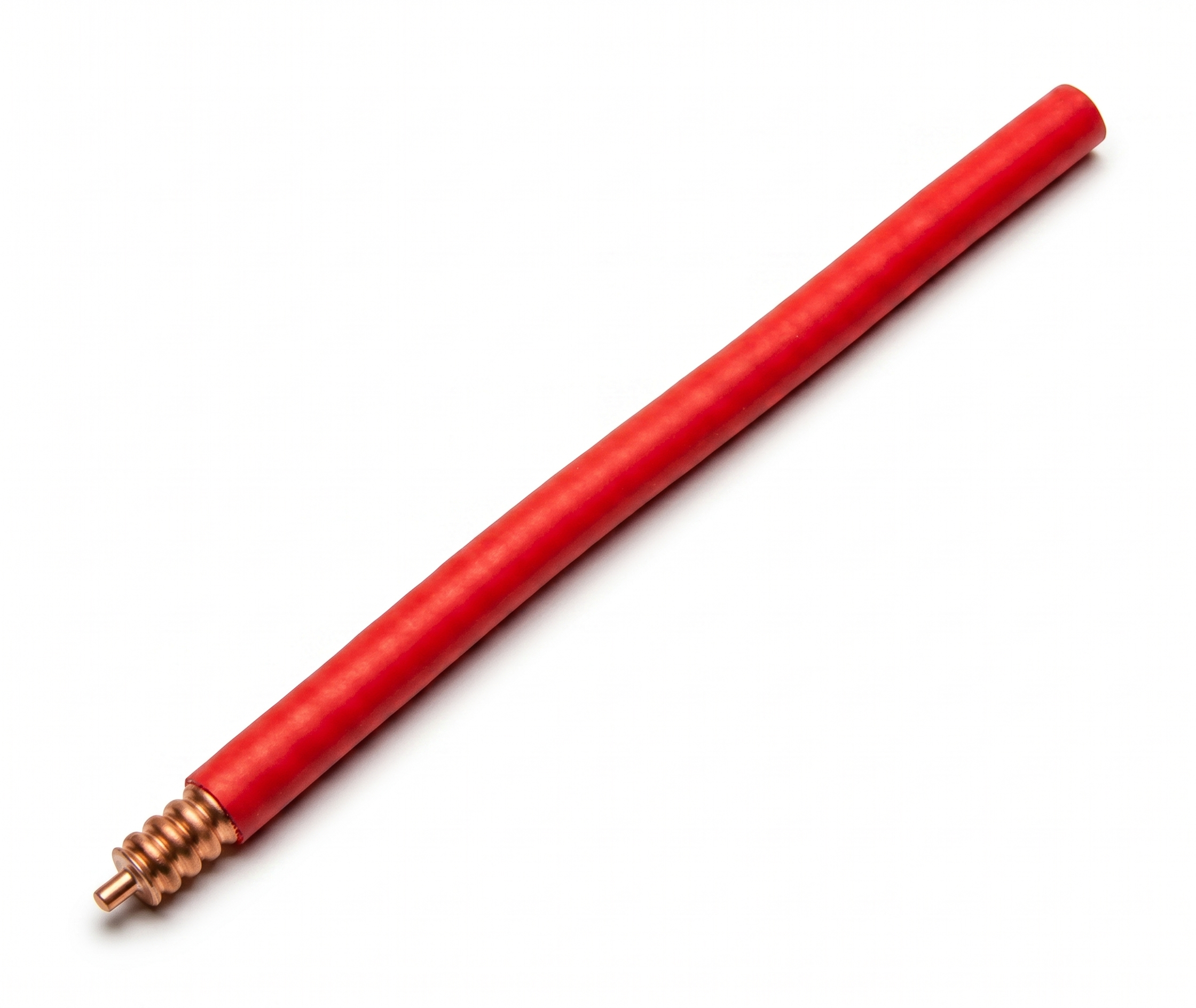
Hefei Bri Electronic & Technology Co., Ltd. is your professional manufacturer for high-performance RF connectivity. Our 1/2″ Air Dielectric Coaxial Cable is expertly engineered for use in Wireless communication, TV & Radio, HF Defense, Mobile Radio, Cable Solutions, and In Building applications. When building a critical public safety distributed antenna system, network reliability is paramount. While this specific model features a white PVC jacket, we offer fully customized solutions including fire-resistant plenum cable, high-visibility 1/2″ yellow coaxial cable, and safety-compliant 1/2″ red coaxial cable to meet stringent indoor building codes.
Reviewing our complete 1/2″ coaxial cable specifications, engineers will find a robust copper clad aluminum wire inner conductor and extruded polyethylene insulation. This serves as an incredibly efficient, low-loss transmission alternative to standard 1/2″ foam-dielectric coaxial cable. For specialized tunnel or long-corridor coverage, our comprehensive catalog also includes 1/2 radiating coaxial cable to guarantee seamless cellular radio transmission. Capable of handling a maximum operating frequency of 6 GHz, our standard 50 Ω cables are the definitive choice for demanding RF feeder networks. For optimal Low PIM performance, terminate your cables with our precision N female connectors.
What is a Plenum Cable?
In building construction, the “plenum space” refers to the area used for air circulation in heating and air conditioning systems—typically the space above a dropped ceiling or below a raised floor. A plenum cable is specifically manufactured with a highly fire-retardant jacket (often FRNC or specialized fluoropolymers) designed to restrict flame propagation and severely limit the amount of toxic smoke emitted if a fire occurs.
The Advantages of the 1/2″ Plenum Cable
For system integrators and building owners, deploying a 1/2″ plenum cable offers several vital advantages:
Strict Fire Code Compliance: The most significant advantage of a plenum cable is safety. Local building codes heavily regulate the types of materials allowed in air-handling spaces. Using a 1/2″ plenum cable ensures full compliance with stringent indoor safety regulations, preventing costly ripped-out installations and failed inspections.
Essential for Public Safety Networks: When deploying a Public Safety DAS, the network must remain operational during an emergency. The fire-resistant nature of a 1/2″ plenum cable provides an added layer of survivability for critical first-responder communications.
Uncompromised RF Performance: Upgrading to a fire-retardant jacket does not mean sacrificing electrical performance. Our plenum-rated options maintain the precise 50 Ω impedance, broad frequency range capabilities (up to 6000MHz), and low signal attenuation required for modern 5G cellular networks.
Reduced Installation Costs: Because a plenum cable can be routed directly through open air-circulation spaces without the need to install expensive, heavy metal conduits, it significantly reduces both material costs and installation labor time.
Technical Specifications: 1/2″ Air Dielectric Coaxial Cable
Material and Dimensions
Inner conductor: Copper Clad Aluminum wire , Ø 4.80 ± 0.10mm
Insulation: Extruded Polyethylene , 11.80 ± 0.20mm
Outer conductor: Corrugated Copper , Ø 13.80 ± 0.15mm
Jacket: PVC Color White , 15.90 ± 0.20mm
Electrical Specifications
Impedance: 50 ± 1 Ω
Relative Velocity of Propagation: 88%
Capacitance: 76 pF/m
Maximum Operating Frequency: 6 GHz
Peak Power Rating: 40 kW
Jacket Spark Test Voltage: 8000 Vrms
Inner Conductor DC-resistance: ≤ 1.62 Ω/km
Outer Conductor DC-resistance: ≤ 1.90 Ω/km
VSWR (680MHz-960MHz): ≤ 1.15
VSWR (5150MHz-6000MHz): ≤ 1.29
Mechanical and Environmental Specifications
Tensile strength: 1120 N
Min. bending radius (single): 76mm
Min. bending radius (repeated): 127mm
Bending moment: 4.1 Nm
Flat plate crush strength: 19.2 N/mm
Operating Temperature (PVC): -40°C to +85°C
Installation Temperature (PVC): -20°C to +60°C
Attenuation (Typical)
450 MHz: 4.84 dB/100m at 1.49 kW Power
900 MHz: 7.08 dB/100m at 1.02 kW Power
2000 MHz: 11.20 dB/100m at 0.65 kW Power
2700 MHz: 13.30 dB/100m at 0.55 kW Power
6000 MHz: 22.80 dB/100m at 0.34 kW Power
Frequently Asked Questions (FAQ)
1. Why is this cable recommended for a public safety distributed antenna system?
A public safety distributed antenna system requires absolute reliability. Our 1/2″ Air Dielectric Coaxial Cable provides exceptional signal preservation up to 6 GHz , while operating reliably in temperatures ranging from -40°C to +85°C. For indoor routing, utilizing a specialized 1/2″ red coaxial cable or plenum cable ensures code compliance and instant visual identification for first responders.
2. How do the 1/2″ coaxial cable specifications compare to standard foam lines?
When reviewing the 1/2″ coaxial cable specifications, you will see that the air dielectric design with extruded polyethylene insulation achieves an excellent 88% velocity of propagation. This often provides lower attenuation for high-power applications (up to 40 kW) compared to a standard 1/2″ foam-dielectric coaxial cable.
3. When should I choose a 1/2 radiating coaxial cable over this standard line?
This standard cable is designed to transport RF signals directly from a source to an antenna with minimal loss. However, if you are attempting to provide continuous coverage in a tunnel, subway, or long elevator shaft, you should specify a 1/2 radiating coaxial cable. Radiating cables act as a continuous antenna, emitting and receiving signals uniformly along their entire length.
Reviews
There are no reviews yet.