In the quiet suburbs and bustling city centers of the modern world, an invisible revolution is taking place. It’s not a change you can see, but one you can certainly feel: the blistering speeds and seamless connectivity of 5G. While the deployment of 5G relies on many technological advancements, perhaps none is more critical, more transformative, or more visually striking (when visualized) than Massive MIMO.
Massive MIMO, or Multiple-Input, Multiple-Output, is the cornerstone technology that allows 5G networks to deliver on their promise of Gigabit speeds and massive capacity. To truly appreciate this antenna renaissance, we must understand its lineage, its definition, and the challenges engineers face in making it work.
The Foundation: Understanding MIMO’s Journey (from 2G to 4G)
Before “Massive” was attached, MIMO (Multiple-Input, Multiple-Output) was already changing wireless communication. The core concept is simple: use multiple antennas at the transmitter (e.g., the base station) and multiple antennas at the receiver (e.g., your smartphone) to improve communication performance.
Traditionally, radio systems were SISO (Single-Input, Single-Output)—one antenna sending to one antenna. While robust, this model is fundamentally limited by the amount of spectrum available and signal interference. MIMO changes the game by using two key techniques: spatial multiplexing and diversity.
Spatial Multiplexing: This allows the simultaneous transmission of different data streams (e.g., part of a movie download) over the same frequency channel. A 2×2 MIMO system (2 transmit antennas, 2 receive antennas) can, in ideal conditions, double the data rate without needing more spectrum.
Diversity: This improves reliability. By transmitting the same signal over different antennas, the system overcomes the problem of signal fading, where one antenna’s signal might be blocked while the other’s is clear.
MIMO in the 4G Era
MIMO truly came into its own with 4G LTE. The standardized configuration for high-performance 4G networks became 4×4 MIMO antenna systems. This meant towers had four antennas transmitting, and advanced smartphones were equipped with four antennas receiving. This configuration was instrumental in 4G delivering speeds that surpassed many home broadband connections.
4G also introduced early forms of multi-user MIMO (MU-MIMO), allowing a base station to communicate with two users simultaneously, further boosting network efficiency. However, in the 4G era, antenna counts were limited by cost, size, and computational complexity. The standard remained a fixed, symmetric allocation.
The Distributed Antenna System (DAS) Interlude
While MIMO was boosting performance in open areas, the challenge of providing strong cellular coverage inside large buildings like stadiums, airports, and high-rises persisted. This led to the development of DAS (Distributed Antenna System).
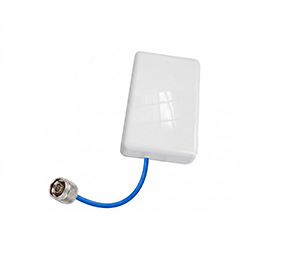
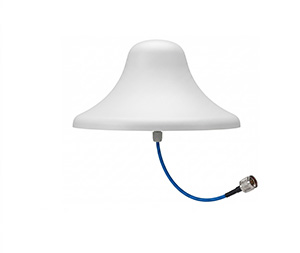
A Distributed Antenna System design differs from MIMO by distributing many smaller, low-power antenna nodes throughout a building, all connected to a central controller. Its goal is not high-speed data multiplexing, but robust coverage and capacity where the outdoor macro tower cannot reach. A well-executed Distributed Antenna System design ensures there are no dead zones inside a skyscraper. Today, 5G Distributed Antenna Systems are increasingly utilizing MIMO configurations (like 2×2 DAS) at each distributed node to deliver high-quality indoor 5G.
Why Massive MIMO in 5G is Necessary
As the world shifted from 4G to 5G, the limitations of traditional 4×4 MIMO became apparent. We needed more than just a slight boost; we needed a paradigm shift.
The 5G Spectrum Conundrum
To deliver on its high-speed promise, 5G utilizes new spectrum, particularly Mid-Band (C-Band, 3.5GHz – 6GHz) and High-Band (mmWave, above 24GHz).
Higher Capacity, Shorter Range: These frequencies are massive data pipes (offering hundreds of MHz of spectrum). However, they have a serious drawback: their radio waves are significantly shorter and do not travel as far, nor do they penetrate obstacles (like walls or trees) as effectively as the low-band 4G spectrum (like 700MHz).
The Propagation Problem: If you deploy a standard 4G antenna at 3.5GHz, its coverage footprint will shrink dramatically, requiring thousands of new cell sites to provide the same coverage. This is economically unfeasible.
The primary reason for Massive MIMO in 5G is to solve this propagation problem.
Defining “Massive”
Massive MIMO takes the multiple-antenna concept and scales it dramatically. Instead of 4 or 8 antennas, a Massive MIMO base station might feature an array of 64, 128, or even 256 miniature antenna elements. These elements are integrated into a single panel, far larger than a 4G antenna. These are not simple dipole antennas; they are complex mimo antennas working in concert.
The Advantages of Massive MIMO in 5G
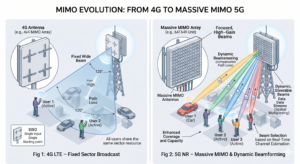
The advantages of this scale are best understood by visualizing how the antenna energy is controlled. The illustration below contrasts the broadcast method of 4G with the precision focusing of 5G.
1. Precision Beamforming (Energy Focusing)
This is the key breakthrough. A standard 4G antenna broadcasts a wide, static beam of energy over an entire sector (like a wide floodlight, Fig 1, left). A Massive MIMO array, however, functions like a collection of advanced lasers.
By precisely controlling the phase and amplitude of the signal fed to each of its 64+ elements, the Massive MIMO system can use constructive interference to create highly focused, steerable beams (Fig 2, right). This process, known as dynamic beamforming, focuses radio energy directly at the specific user equipment (UE)—whether it’s a car or a smartphone.
Benefit: This focusing action compensates for the high path loss of the 5G mid-band spectrum. It ensures a strong, high-quality signal reaches the user, effectively extending the coverage range of the 3.5GHz signal to match or exceed the 4G low-band coverage footprint. This is the ultimate “fix” for the range issue.
2. Spatial Multiplexing on Steroids
While 4G (Fig 1, left) could manage 2 or maybe 4 simultaneous data streams for one user, Massive MIMO can manage 16 or 32 distinct beams simultaneously across the same frequency channel (Fig 2, right). This allows for unprecedented Multi-User MIMO (MU-MIMO).
Benefit: In a crowded environment, multiple users can download data at peak speed simultaneously, because each user has their own dedicated, focused beam that doesn’t interfere with the others. This is the difference between a shared highway lane (4G) and everyone having their own private superhighway (5G Massive MIMO). The overall network capacity is multiplied.
3. Interference Suppression
By focusing signals into narrow beams, a Massive MIMO tower significantly reduces the amount of “spillover” energy—interference—it sends to neighboring cell sectors and users. In standard 4G (Fig 1, left), a high-power broadcast intended for one user creates interference for many others in the same area. Massive MIMO towers communicate with surgical precision, reducing overall network interference and boosting performance for everyone.
The Technical Challenges of Massive MIMO Today
While the theory of Massive MIMO is powerful, implementing it in the real world presents formidable engineering challenges.
1. The Complexity of Channel Estimation
For beamforming to work, the tower must know exactly what the path (the “channel state”) looks like between its array and your specific phone right now. In an urban environment where your phone is moving and signals are bouncing off buildings, this channel is constantly changing.
The Problem: The tower must estimate the channel state (CSI) for 64+ antennas, in real-time, for dozens of simultaneous users, across hundreds of resource blocks. This generates massive computational complexity and requires robust feedback loops, consuming precious network capacity (known as reference signal overhead).
2. Physical and Electrical Demands (The “Hot and Heavy” Problem)
Building and powering a 64×64 or 128×128 antenna array is a massive physical challenge.
Weight and Wind Load: A Massive MIMO unit is significantly larger and heavier than a 4G antenna (compare the units in Fig 1 and Fig 2), placing enormous stress on existing cell towers.
Power Consumption and Heat: Driving 64 separate power amplifiers consumes immense electricity and generates significant heat. This requires active cooling (like fans) and highly efficient semiconductors. Today, the move toward gallium nitride (GaN) power amplifiers is essential, but heat management remains a constant issue in design, especially in warm climates.
3. The Digital Bottleneck
The massive array generates a mountain of data. The connection from the antenna panel down to the baseband unit (BBU) at the ground must handle an overwhelming data rate (tens of Gigabits per second).
The Problem: The traditional Fronthaul connection (CPRI) cannot scale to Massive MIMO. Operators must adopt new, high-speed interfaces like eCPRI (enhanced CPRI) and use optical fiber connections to move data fast enough. Even then, the computational load on the baseband processor can become a bottleneck, requiring highly advanced, expensive processing chips.
4. Cost and Deployment
Massive MIMO equipment is far more expensive than 4G equipment. The required upgrades (new towers, stronger mounts, fiber fronthaul, enhanced power supply) mean deploying 5g distributed antenna systems that incorporate mimo antenna 5g units is a multi-billion-dollar endeavor for network operators. This high cost dictates that Massive MIMO is typically only deployed in dense urban or capacity-constrained areas first.
Conclusion
Massive MIMO is not merely an incremental upgrade; it is the definitive antenna renaissance that makes 5G possible. By transforming radio communication from a blunt broadcast tool into a precise, steerable laser, it solves the fundamental coverage challenges of new spectrum and unlocks unprecedented capacity. While massive in size, scale, and complexity, its impact is even larger. As we look to the future, the ongoing evolution of these mimo antennas will continue to define the speed and reliability of our connected world.