Beyond the Speed Limit: Why 6G is a Paradigm Shift, Not Just “5G Plus”
When we think about the evolution of mobile networks, the narrative is usually linear: 1G let us talk, 2G let us text, 3G brought the internet to our pockets, 4G gave us streaming video, and 5G connected our machines. It is tempting to look at the upcoming 6th Generation (6G) of wireless technology and assume it will merely be “5G Plus”—a network that simply downloads movies a bit faster or connects a few more smart home devices.
However, this assumption fundamentally misunderstands the technological leap that 6G represents.
6G is not just about expanding bandwidth or shaving off a few milliseconds of latency. It is about moving from “connected things” to “connected intelligence.” It is a paradigm shift that will seamlessly merge the physical, digital, and biological worlds. By natively integrating Artificial Intelligence (AI) and expanding infrastructure beyond the surface of the Earth, 6G will act as a centralized nervous system for the planet.
The Six Application Scenarios of 6G
To understand why 6G is a revolutionary leap rather than an evolutionary step, we must explore the International Telecommunication Union’s (ITU) framework for 6G (officially known as IMT-2030), which outlines six core application scenarios. While three of these are massive upgrades to existing 5G capabilities, three are entirely new frontiers.
1. The IMT-2030 6G Usage Framework
The foundation of 6G is built upon six distinct usage scenarios. Image 1 visualizes this framework, showing how the classic three 5G scenarios have evolved and how three entirely new ones have been added.
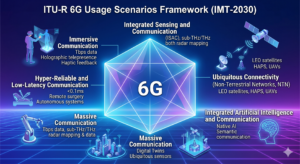
Image 1: A detailed diagram visualizing the complete ITU-R 6G usage scenarios framework (IMT-2030), illustrating the six core application categories.
2. Immersive Communication (The Evolution of eMBB)
In the 5G era, Enhanced Mobile Broadband (eMBB) allowed us to stream 4K video on the go. 6G’s Immersive Communication takes this to the extreme, with data rates reaching 1 Terabit per second (Tbps). This pipeline is required for extended reality (XR), high-fidelity holographic telepresence, and multi-sensory communications. Imagine a video call where you not only see and hear the other person, but also experience haptic feedback, such as feeling the texture of an object they are holding.
3. Hyper-Reliable and Low-Latency Communication (The Evolution of URLLC)
5G introduced Ultra-Reliable Low-Latency Communication (URLLC) for factory robotics. 6G pushes this into the absolute. With latencies expected to drop below 0.1 milliseconds, 6G will enable applications where human reaction times are too slow, including fully autonomous intersection management and real-time remote robotic surgery across continents.
4. Massive Communication (The Evolution of mMTC)
Massive Machine-Type Communication (mMTC) connected millions of sensors. 6G expands this to billions of devices, supporting the creation of massive, high-fidelity Digital Twins. A Digital Twin is a perfect, real-time virtual replica of a physical system—like an entire smart city or a human body. Maintaining these twins requires an uninterrupted, massive flow of data from ubiquitous micro-sensors, which 6G facilitates.
5. Integrated Artificial Intelligence and Communication
This is where 6G breaks new ground. In 5G, AI was an add-on. In 6G, AI is native. The network itself acts as a massive distributed computer capable of Semantic Communication, meaning the network understands the meaning of the data it transmits. 6G will offer “AI-as-a-Service,” allowing devices with low computing power to tap into the network’s embedded intelligence.
While these advancements are incredible, the true core of the “6G is not just 5G+” argument lies in the final two scenarios: Integrated Sensing and Communication (ISAC) and Ubiquitous Connectivity via Non-Terrestrial Networks (NTN). These two concepts fundamentally change what a cellular network is.
Deep Dive: Integrated Sensing and Communication (ISAC)
Historically, wireless communication and radar sensing have been separate technologies. 6G introduces Integrated Sensing and Communication (ISAC). Using sub-terahertz (sub-THz) and terahertz (THz) bands, 6G utilizes incredibly small and directional radio waves. This allows the same radio signals used for communication to also act as a highly precise radar.
Image 2 provides a detailed visualization of how this ISAC system works.
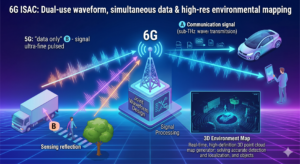
Image 2: An illustrative diagram explaining the ISAC mechanism in a 6G network. It highlights how a single sub-THz waveform simultaneously transmits data to a user (Path A) and maps the environment by analyzing reflected echoes (Path B) to create a high-definition 3D map.
How ISAC Works
As visualized in Image 2, the 6G network sends a signal to a user (Path A). However, as that radio wave bounces off the environment—cars, buildings, and pedestrians—the echoes (Path B) return to the base station. By analyzing these echoes, the network instantly maps its surroundings in 3D. The network is no longer just a pipeline; it is a giant, pervasive sensor.
Transformative ISAC Applications
Smart Traffic and Autonomous Driving: Today, autonomous cars rely on onboard sensors. With 6G ISAC, the network itself tracks everything. A 6G streetlamp can “see” a pedestrian behind a truck and warn an oncoming car, even if the car’s own cameras cannot see the pedestrian yet.
Privacy-Preserving Healthcare: 6G routers can monitor breathing patterns and heart rates of nursing home residents and detect falls purely through radio wave reflections, without invasive video cameras.
Deep Dive: Ubiquitous Connectivity and Non-Terrestrial Networks (NTN)
The greatest limitation of previous cellular generations is that they are fundamentally terrestrial, relying on ground-based towers that cover only about 20% of the Earth’s surface. 6G aims to achieve Ubiquitous Connectivity, meaning absolute, 100% global coverage without a single dead zone.
To do this, 6G must incorporate Non-Terrestrial Networks (NTN) directly into the cellular standard, creating a multi-layered, 3D network architecture, as illustrated in Image 3.
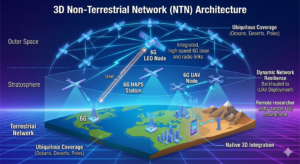
Image 3: A multi-layered 3D architecture visualization of 6G Non-Terrestrial Networks (NTN). The dynamic visualization shows how LEO satellites, HAPS, and UAVs are seamlessly integrated with ground-based 6G towers to provide ubiquitous connectivity across the entire planet, including remote deserts and oceans.
The Architecture of NTN
As visualized in Image 3, 6G devices will fluidly connect to a web of space-based and aerial nodes:
Low Earth Orbit (LEO) Satellites: Constellations providing high-speed broadband to remote areas.
High-Altitude Platform Stations (HAPS): Giant solar-powered drones or balloons floating 20 kilometers high, acting as “cell towers in the sky.”
Unmanned Aerial Vehicles (UAVs): Lower-altitude drones deployed on demand, for example, to restore communication instantly during natural disasters.
Your standard 6G smartphone will have the antennas and AI to seamlessly switch connections between ground towers, drones, and satellites as you move.
Conclusion: The Era of Connected Intelligence
If 5G was the highway that allowed machines to drive quickly, 6G is the nervous system that allows the environment to think, feel, and react.
We conclude with Image 4, which synthesizes all these concepts, showing the powerful convergence of all six 6G application scenarios into a single intelligent environment.
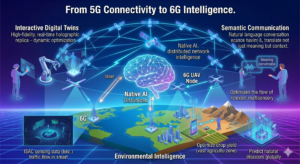
Image 4: A conceptual synthesis visualization summarizing the entire 6G vision. It illustrates the merge of physical, digital, and biological worlds, powered by a single intelligent environment that unifies ubiquitous coverage (NTN), pervasive sensing (ISAC), and native AI to generate environmental intelligence.